
The Best Historic Conference Venues in Leeds: Where Heritage Meets Modern Events
When you think of Leeds, you probably think about a dynamic and highly modern city. After all it is one of the fastest growing UK cities with nearly a quarter of the population aged between 18 and 29, and an excellent example of a city combining culture, business and shopping, with fantastic nightlife & restaurants.
This is all true but Leeds (previously known as Loidis, Ledes and Leedes) also has a rich historical background, with stunning architecture predominantly from the Victorian Era. Within a short walk, you can move from a Georgian church to a cutting-edge conference suite, from Victorian grandeur to contemporary luxury. Add in excellent transport links, a thriving hospitality scene, and our warm Yorkshire welcome, and you’ve got the ideal destination.
What truly sets Leeds apart is how seamlessly the city blends history with innovation, and you can also find this in many of the unique venues across the city centre. Read on to discover more about some of the fascinating stories behind Leeds’ best historic conference venues.
Cloth Hall Court
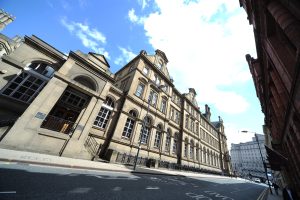
Cloth Hall Court stands on the site of the original 18th-century Leeds Cloth Hall, once the beating heart of the global wool trade.
The largest space, the Herringbone suite (all rooms are named after textiles, fabrics, and the garment industry) can accommodate up to 300 delegates. The whole building is fully refurbished with built in state-of-the-art AV, breakout areas, and the flexibility to suit any conferencing arrangement. The venue has an elegant courtyard setting and is ingrained in the fabric of our vibrant city-centre, only a few minutes from Leeds railway station on foot.
Did you know … In the 1700s, Leeds was one of the world’s most important cloth trading centres. Merchants would arrive at dawn to Leeds Cloth Hall to sell woollen cloth under strict supervision, no deals allowed after the trading bell rang. Traders were fined if they tried to leave early or sneak in late
Malmaison Leeds
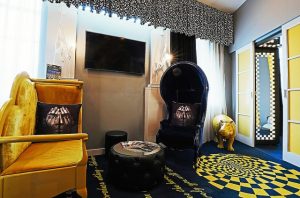
Malmaison Leeds has called Swinegate home since 1999, but this magnificent Victorian red-brick building has a rich history. Tracing its roots back to the turn of 20th Century, Swinegate Depot served as the headquarters of Leeds City Tramways for more than half a century. During World War I, the building was temporarily requisitioned by the war department and transformed into the city’s main recruitment centre and army clothing depot before returning to its role at the heart of Leeds’ tram network.
The hotel now offers a stylish and intimate setting with distinctive character. The largest space can accommodate up to 100 delegates and offers some of the cities most unique and beautiful bedrooms, as well as a very popular bar and restaurant.
Did you know …The last tram in Leeds ran on November 7, 1959. Tram Number 178 returned to Swinegate Depot to find crowds gathered on either side of the tracks to witness the end of an era. The arrival of Malmaison helped pioneer the boutique hotel movement in the North of England, giving new life to one of Leeds’ most historic buildings. Today, Malmaison pays homage to the building’s former life with its ground floor private dining rooms, affectionately named ‘The Ticket Office’ and ‘The Tramshed.’
Where engines and cargo once stood, you can now find cocktails and canapé receptions.
The Queens Hotel
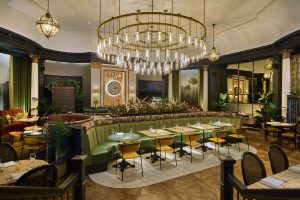
One of Leeds’ most recognisable landmarks, the Queens Hotel was originally opened as a railway hotel in 1863 for the Midland Railway company. It was demolished in 1935 to make way for thew new Queens Hotel, which was opened by the Princess Royal and Lord Harewood on the 12th of November 1937.
With a capacity of 500 theatre style in the stunning Ballroom the hotel offers the largest hotel conference and banqueting facilities in the region and has 15 exceptional event spaces. The Queens also boasts direct station access and striking Art Deco elegance, retaining lots of the original features including their red door lifts, and the windows which are both listed.
Did you know… When The Queens opened in 1937 it was the first hotel in the north of England to feature en-suite bathrooms and air-conditioning in the bedrooms and it cost 10 shillings and 6 pence a night to stay which is roughly £18 in today’s money.
Many famous celebrities have visited or attended an event at The Queens including royalty and prime ministers. One of the most iconic photographs captures Prince Albert and Princess Grace of Monaco attending the High Society Ball on the 26th of October 1972. Other celebrities to stay at the Queens include Laurel & Hardy, Nelson Mandela, Carry Grant, Sir Michael Caine, Roger Moore, and David Niven to name a few.
The motor-room at The Queens still has the original motors that started turning in 1937 and still turn today.
Holy Trinity Church, Boar Lane
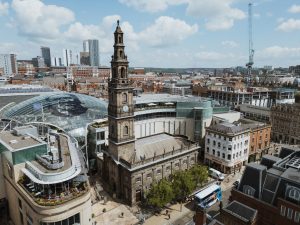
Dating back to 1727, Holy Trinity Church is one of Leeds’ oldest buildings, and a rare survivor of the city’s early Georgian period. With a maximum capacity of 200 reception style or 140 theatre style, the church has beautiful original features including of course stain glass windows. This historic building now houses a contemporary space with underfloor heating and a state-of-the-art A/V system.
Did you know …The church was built when Leeds was still a relatively small town, decades before its industrial explosion. It has witnessed the city’s transformation from market town to manufacturing giant. It also had one of the tallest towers in the city at 171ft, which lasted about 120 years before a hurricane damaged it in 1839. It then was rebuilt to 186ft.
Leeds Town Hall
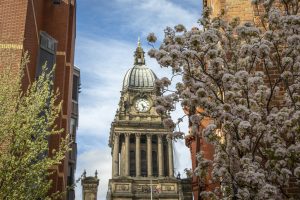
copyright Carl Milner
Designed by architect Cuthbert Brodrick, Leeds Town Hall’s grand interior includes the magnificent Victoria Hall, a courtroom, Bridewell prison cells, and several smaller meeting rooms. Its landmark clock tower provides stunning 360° views of the city. Opened in 1858 by Queen Victoria (marking the visit of a ruling Monarch to the city). Leeds Town Hall was built to showcase the city’s wealth and confidence during the Industrial Revolution.
Currently going through a major refurbishment due to complete in 2027, this will include improved accessible entrances and lifts, a completely new café and bar area as well as improved facilities on all other areas. Victoria Hall can seat up to 1,200 delegates theatre style. This ornate space has hosted a vast range of incredible artists, from the legendary riffs of The Rolling Stones in 1963, Pink Floyd in 1969, Queen and Mott the Hoople in 1973, to the bluesy magic of Rory Gallagher in 1971. It has also regularly hosted Leeds International Piano Competition as well as classical music world premieres. The Town Hall is an iconic location perfect for conferences, dinners and exhibitions.
Did you know … There are hidden tunnels beneath Leeds Town Hall, including one leading to Leeds Central Library.
Notorious Victorian villain Charles Peace, on the run for over 20 years, met his fate within the walls of Leeds Town Hall in 1879. Peace was sentenced to death and it is said his ghost haunts the Bridewell cells to this day.
Leeds Town Hall’s clock doesn’t strike at midnight! There are several myths surrounding why, including that it is so as not to wake the spirit of its resident ghost Mary Blythe who threw herself from the clock tower to her death in 1876 or that it is because if the clock were to chime at midnight on New Year’s Eve you would hear the stone lions roar and suddenly spring to life and run around the city. (It is more likely to let local Leeds General Infirmary patients sleep).
The Met Hotel
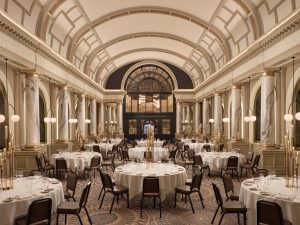
Copyright ryan@ryanwicks.co.uk
Built in 1899 as the Leeds Hotel, The Met reflects the elegance of late Victorian hospitality and is proudly under the watchful protection of a Grade II listing. The hotel was the brainchild of Messrs Chorley (Connon & Chorley) whose work also spans other highly regarded buildings such as Newton Park estate, Leeds Girls’ High School at Headingley, Askham Grange and Westminster Bank.
With a capacity of 250 theatre style in the beautiful Met ballroom, along with another 8 meeting rooms the hotel has just undertaken a major refurbishment including the reception area, conference spaces and bedrooms.
Did you know …. The hotel served as the fictional ‘Marble Arch Hotel’ in the hit 1991 mini-series The Darling Buds of May.
The site on which the Hotel Metropole is located originally formed part of the grounds of Leeds first infirmary. You could say it’s always been a place of care and recovery (now with better beds and far superior wine).
Aspire
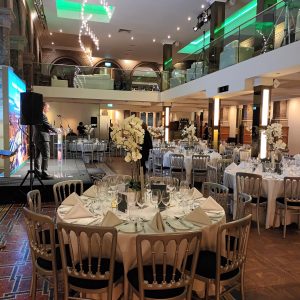
In 1894 the Yorkshire Penny Bank, now Aspire, was erected on the site of the original Leeds General Infirmary making it a Victorian building built just before the Boer War (1899 – 1902). It was known as the West Riding Penny Savings Bank then changed to the Yorkshire Penny Bank.
Aspire was later privately acquired and lovingly restored to its former beauty in 2007. Rich with historic interest and incorporated with striking modern features, this prestigious building now plays host to one of Leeds premier events space.
With a capacity of up to 550 theatre style and located just a 2 min walk from Leeds train station Aspire has held not only conferences but drinks festivals, weddings, fashion shows and has even housed an ice rink for a client event.
Did you know …The Penny Bank building occupies the site of the city’s first purpose-built Leeds General Infirmary, constructed in 1771 and demolished in 1893 to make way for the bank. The dated inscriptions and decorative motifs (including carved dates and symbolic imagery) connect it back to the bank’s founding and mission to promote thrift and financial inclusion in the region.
Leeds City Museum
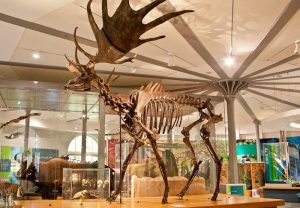
Located in Millennium Square, Leeds City Museum offers a venue quite unlike any other. The museum’s origins date back to 1819, when it was founded by the Leeds Philosophical and Literary Society. It opened to the public in 1821, making it one of the oldest museums in Yorkshire.
With a capacity of 220 theatre style the impressive Brodrick Hall is ideal for presentations, dinners and conferences. It also offers a selection of smaller meeting rooms and interactive galleries – Life on Earth, Leeds Story and Ancient Worlds which provide a stunning setting to host drinks & canape receptions or pre-dinner drinks offering guests a private view of the gallery.
The museum’s collections explore everything from ancient Egypt to Leeds’ industrial heritage, reflecting the city’s global connections.
Did you know The Leeds Tiger (a preserved Bengal tiger) and an Egyptian mummy are among its famous residents, ideal icebreakers for networking sessions.
In the museum’s central hall, visitors can walk across a large floor map of Leeds and explore a scale model of the historic Quarry Hill Flats, once one of Europe’s largest social housing developments.
Ready to Host Something Extraordinary?
In Leeds, your event isn’t just another date in the diary, it becomes part of a much bigger story. From cloth traders and railway pioneers to modern innovators, this is a city built on bringing people together.
Let Conference Leeds help you find your perfect venue. Contact us on info@conferenceleeds.co.uk or give us a call on 0113 378 1163.